
Among the myriad fasteners in the mechanical world, nuts may seem insignificant, yet they are crucial. Among them, hex nuts and locking nuts are the two most common and essential types. Their fundamental difference lies not in their appearance, but in their design purpose and core function: the former is the "main force" providing basic connection strength, while the latter is the "safety lock" preventing loosening.
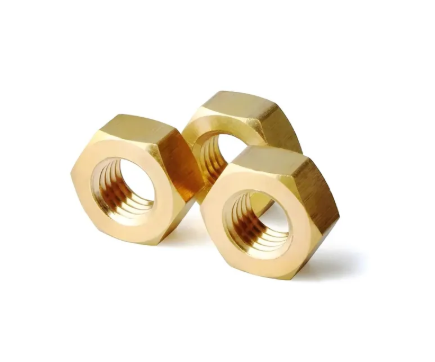
Standard Connecting Part: Hex Nut
The hex nut, also known as a standard nut, derives its name directly from its regular hexagonal external geometric shape. This classic design provides multiple wrenching surfaces, facilitating efficient tightening or loosening in confined spaces using common tools (such as wrenches and sockets). Its main purpose is to work with bolts or screws, applying axial preload to firmly clamp two or more parts together, undertaking the main task of connection and load bearing.
However, under prolonged vibration, impact, or alternating loads, the friction between ordinary threaded pairs may gradually decrease, leading to unexpected reverse rotation and loosening of the nut. This is the inherent limitation of ordinary hex nuts, paving the way for the emergence of locking nuts.
Anti-Loosening Expert: Locking Nut
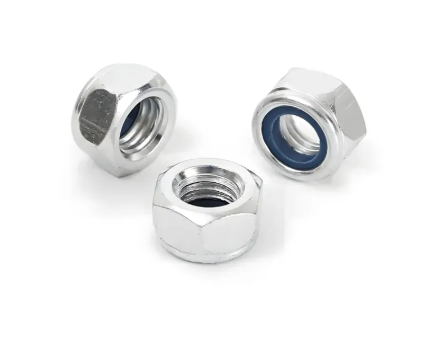
Locking nuts, as the name suggests, have the primary and core objective of effectively preventing self-loosening under dynamic working conditions. It is a functional umbrella term, and its anti-loosening principles are diverse, mainly achieved by increasing additional friction or mechanical interference. Common types include:
Nylon locking nuts (nylon insert nuts): A ring of engineering nylon is embedded in the top of the nut. When the bolt is screwed in, the nylon is compressed, generating significant elastic contraction force, creating continuous radial pressure to achieve "elastic locking."
All-metal locking nuts: For example, crown nuts with a slot and slightly narrowed opening at the top, or those with an elastic non-circular opening on one side (deformed tooth locking nuts). They utilize the elastic deformation of the metal itself to generate additional interference and friction at the threaded engagement. Double Nut Structure: This method uses two standard nuts, a main nut and a secondary nut, tightened against each other to create additional tension between the threads. This is a classic and practical anti-loosening method.
Therefore, the selection of these two types of nuts follows a clear logic: Hex nuts are widely used in basic connection scenarios that are static, have relatively stable loads, and do not require extreme anti-loosening measures, such as ordinary steel structures and furniture assembly. Lock nuts, on the other hand, are essential for vibrating environments and are commonly found in critical parts of car chassis, railway tracks, aerospace vehicles, heavy machinery engines, and precision instruments where high reliability is required.
From the simple hexagonal shape to the ingenious anti-loosening design, the evolution of nuts reflects the relentless pursuit of reliability in industrial equipment. Understanding the fundamental difference between these two types of nuts is not only about choosing the right parts, but also about securing a crucial link for the long-term safe operation of mechanical systems.